WHEN I SQUINT MY EYES, I SEE YOU FOR WHAT YOU TRULY ARE///
I CANNOT SEE FAR AHEAD OF ME, and most days I choose not to wear my glasses. I enjoy my own vision, the fuzziness of things five feet or more ahead of me.
But I am never without this choice- I bring my glasses with me most everywhere because there are times I know that I cannot get away with remaining ignorant or straining my eyes.
i
I WAS THINKING about this choice and how good it would be to have my glasses with me when I walked into Maria Loutzakli’s exhibit ‘What the Statues See – The Invisible Life of the Acropolis Museum and It’s Residents’ curated by Christoforos Marinos.
This exhibit was being displayed in the Centre of Mediterranean Architecture, or the Grand Arsenal – a heritage building in Chania, a vibrantly colourful city in the North West of the Greek island of Crete. Google searched images will yield innumerable amounts of photos of their Venetian port featuring the terracota coloured mosque at its centre.
I walked into the cavernous space of the Grand Arsenal as two attendants spoke animatedly to each other in Greek. Fumbling through my bag for glasses I could not initially find, I squinted at the walls of the space and was confronted by a photography exhibition.
The question Maria Loutzalki posited as the subject of this work was ‘What are the objects of their [the statues’] own gaze?’ – Loutzalki is referring to the Acropolis Museum statues’ gaze in this question.
She tracked their gaze over eighteen months, her images capturing both the outside of the museum bathed in light to the wavy image of a statue reflected in a puddle on an overcast day. These represented the visual changes of seasons.
>Do the statues get seasonal depression?
>Do they wish they were back on top of the hill again?
Not only did these photos express what Loutzalki figured the statues were staring at, it evoked the questions of what the statues had seen before> Before they were looking at you and me they were looking at them and her and him.
It made me wonder how the statues felt being carved from blocks of marble – Did they have feeling in the block or was it only when their eyes were sculpted that they saw/ How did they feel being set in the Acropolis/ Were they sad when archaeologists took them from their hiding spots, their resting spots/ Do they miss the pillars of their homes.
Loutzalki’s work represented an intersection of industries – her occupation being a psychotherapist, her medium being photography, the reception being those with backgrounds in art and working histories in cultural institutions. A reminder in the multiplicities of sights we hold in us.
ii
THE NEXT DAY I WALKED ALONG Chania’s shimmering blue coastline on my way to the house museum of former Greek Prime Minister Eleftherios Venizelos.
Unlike the day before stumbling upon Loutzalki’s exhibit, this day I was specifically in search of something I knew historical perspective would be able to give me – a sense of comfort. To be reminded of the continual nature of people is something which museums are in a unique position to do.
I went in not knowing who exactly Venizelos was, and finding out he was the former prime minister of Greece took me some time. I was not searching for who Venizelos was in his house, I was looking for what he could give me.
In his own living room I fumbled around with a pamphlet telling me the timeline of his life in my left hand while my right fished through my bag for the hard green case of my glasses.
Putting them on, I walked through the walls that once rose around Venizelos.
I looked at the tea set positioned just so on the desk in the refurbished dining room. Venizelos’ second wife had the place redecorated in the 1920s and the Municipality of Chania promises that the house is kept this way.
During World War II, Nazis overtook the house and left their mark in the form of destruction and murals of Greek mythology in a small room on the ground floor. Keeping these murals was another choice the museum had taken by counting the Nazis contribution as integral to the house’s history.
I was wondering what Eleftherios would think of that when I walked via the library into an exhibit the museum had installed which explained his book collection. Part of this was dedicated to his translation of The History of the Peloponnesian War written by Greek historian Thucydides.
It explained that Venizelos self exiled several times in his lifetime and during one self exile in Paris he began this massive undertaking.
The curator of the exhibit wrote that he ‘considered reading Thukidides as a major asset for an insight into modern events, and his philosophy and historical thinking as guide to every important contemporary political action.’ This felt like what I was searching for.
We looked each other in the eye as he explained that yes, a little over a century ago I also sought out perspective in some other guy’s ideas.
> I wonder how Venizelos would feel if he knew his house was being looked at like this/ That it was not just inherited or sold or falling into disrepair/ That someone who had no idea of him was allowed to look at his bedroom.
> Would he ask me for my perspective?
iii
LATER ON THIS TRIP a friend joined me in the city of Athens.
A place we decided rides on the coattails of its own mythology.
Our second morning we hiked up to the Acropolis.
A site where in more ancient times people worshipped the gods through honouring bodily pleasures, drinking and talking and loving and laughing.
On this day we reached these pillars feeling very delicate from our Dionysus-like indulgences the previous evening.
This irreverent scenario we found ourselves in created a connection with the ancient people and our ancient gods that I did not expect. As we sat on the crowded steps watching this site teeming with people from all over try to appreciate the history of the place – and most often fail, I felt more and more at ease amongst it all.
A German couple stood in front of my friend and I in visors, grimacing at both each other and the prospect of walking even further to get to the Temple of Athena.
An American woman stood behind us telling the story of how she was videoing at the top of a mountain and did not realise there was a woman stripping naked at the side of the frame until she watched it back later. Oh she laughed and laughed.
A woman whose nationality we could not decipher yelled at her unconforming husband and bickering children to stop and take a picture.
People screaming at each other, calling after each other – for water, for photos, to keep going, to slow down, asking how much longer the others wanted to stay and pronouncing they did not care to go any further – that they themselves had seen enough.
As we ascended the steps and the city sprawled down beneath us I wondered what people before us had thought, were they in reverence of the temples/ Or were they, like me, preoccupied with idle gossip and how hot the sun was that day? Was their Acropolis companion also wondering if there was a toilet up here?
Only when we reached the Parthenon which baked in the heat of this day were we finally speechless.
iv
SLIDING ALONG the slick stone of the streets smoothed by so much wear, we finally made it to the Acropolis Museum [Separate to the Acropolis itself].
Beginning the day looking at the real thing, we looked forward to see what should be in, on and around these bare temples.
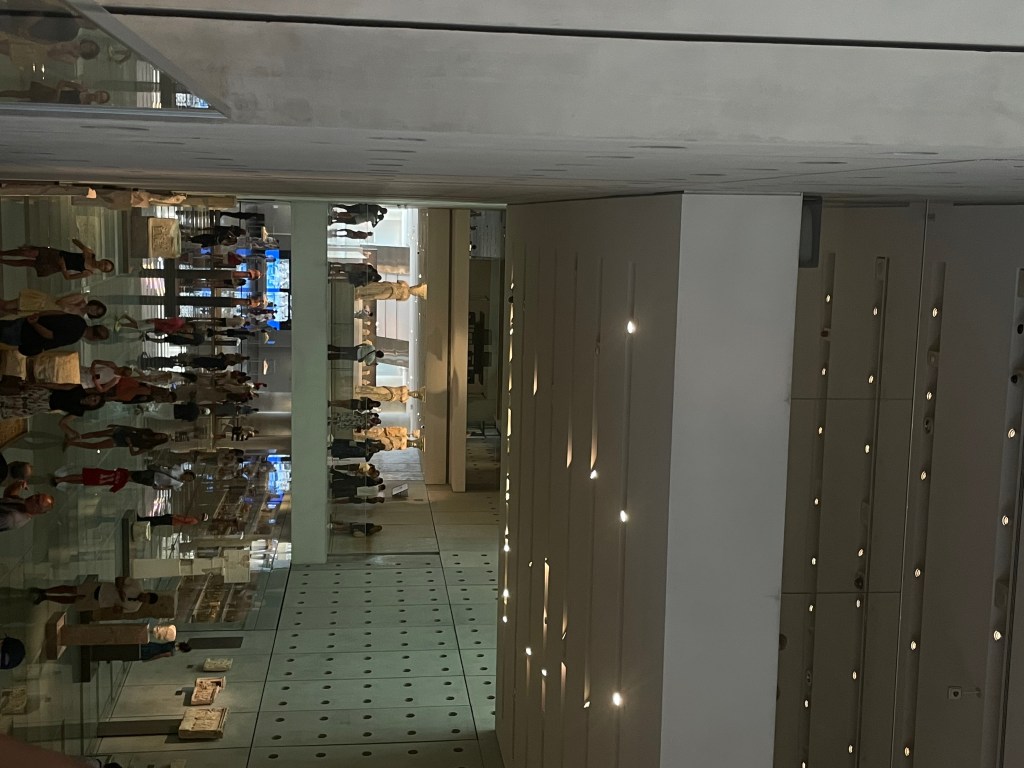
Like Loutzalki’s exhibit, the museum was almost cold from air conditioning, and I tried to keep her work in my mind’s eye when we entered the ground floor gallery featuring so many busts and statues.
But we found ourselves mesmerised by the people walking around. We wondered what our fellow patrons could be looking for from this experience.
> I wonder if I had gone alone to both sites if I would have seen something different?
The families, couples, single people, iterations of three we could not quite define, groups of four, five, six who all looked the same age.
As the evening light streamed through the floor to ceiling windows, we walked in circles and wondered aloud who was mad at each other, how many days into a trip people must be in/
> I wondered where and when Loutzalki felt the statues’ gaze in a place so full of motion.
Delivered to the second floor via escalator, we forewent the educational video playing right ahead and turned left into the viewing gallery of the Acropolis staring down at us.
Turning around as we sat down on the long wooden bench by the window we found ourselves naturally looking up towards the metope hung just under the ceiling. And I felt the stare that she saw in them.
Looking at each other look at others together all day.
I did only use my memory here 🙂

